
Projector vs TV Home Theater Choosing Your Perfect Screen
So, you’re building a home theater. The first, and biggest, question you need to answer is this: projector or TV? It really comes down to what you’re trying to create. Are you after that massive, immersive, movie theater at home feeling, or do you need a bright, vibrant screen that works just as well for Sunday morning football as it does for Friday night blockbusters?
For a dedicated room where you can kill the lights, a projector’s sheer scale is impossible to beat. But in a bright, multi purpose living room, a high end TV is the undisputed champ for practicality and power.
Choosing Your Perfect Screen
Picking the centerpiece for your home theater is the most important decision you’ll make. Sure, both modern projectors and top tier TVs offer stunning 4K HDR visuals, but they get there in completely different ways. This choice will ripple through everything. Your room’s layout, lighting, budget, and even your daily viewing habits. We’re going to move past the spec sheets and dig into the real world trade offs to help you match the right tech to your vision.
Let’s get one thing straight from the start. This isn’t just about technology; it’s about the experience each one is designed for. A projector exists to replicate the commercial cinema experience, where scale and immersion are king. A TV, on the other hand, is built for convenience and peak performance in all sorts of lighting conditions, making it the perfect all around entertainment hub.
Projector vs. TV At a Glance
Getting a handle on these foundational differences is key. A projector setup has more moving parts: the projector itself, a screen, and almost always a separate sound system, which means more planning. A TV is essentially an all-in-one solution that you can have up and running in under an hour.
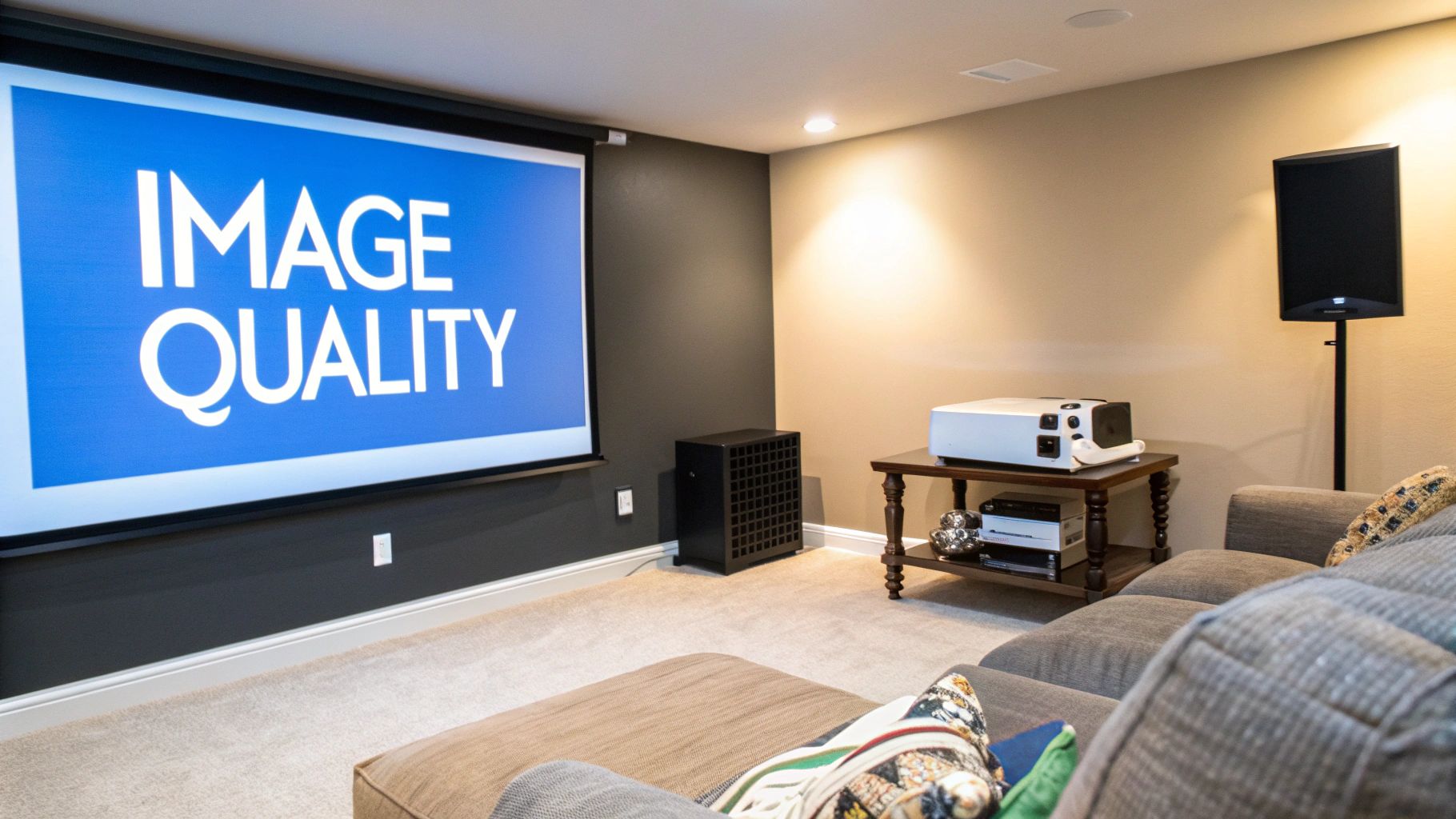
The real question isn’t which one is “better,” but which is better for your specific room and lifestyle. A bright, airy living room will absolutely neuter a projector’s performance, while a giant TV might just overwhelm a smaller, dedicated theater space.
This table cuts through the noise and lays out the critical distinctions to frame your decision.
| Feature | Home Theater Projector | Large Screen TV |
|---|---|---|
| Maximum Screen Size | Easily hits 120 inches or more. Your only real limit is wall space. | Generally tops out at 85 to 98 inches. Going bigger gets ridiculously expensive, fast. |
| Performance in Bright Rooms | Struggles with ambient light. It demands a dark or light controlled room to truly shine. | Excellent. A TV’s powerful, direct light source cuts through daylight like a champ. |
| Cost Per Inch | Becomes dramatically more cost effective once you go above 85 inches. | The price per inch for the biggest screens is incredibly high. |
| Immersion Factor | Unmatched cinematic feel. The massive, reflective image completely fills your field of view. | Very immersive, but the smaller scale can feel less “cinematic” than a true projector setup. |
| Installation & Space | More involved. It requires careful mounting and screen installation, but the screen can retract and disappear. | Simple setup. But the TV itself is a big, permanent fixture on your wall or a stand. |
Comparing Image Quality and Visual Performance
Beyond just the size of the screen, the real debate between projectors and TVs kicks off when we talk about visual performance. Both technologies can deliver stunning 4K resolution and vibrant HDR, but they create those images in fundamentally different ways. This creates two very distinct viewing experiences, and understanding the nuances of contrast, color, and brightness is key to making the right choice for your home theater.
A television uses emissive light, which means the screen itself is the source of the light you see. This direct approach is a TV’s superpower, especially for OLED and high-end QLED models. It allows them to get incredibly bright and control light on each pixel, making them fantastic performers in a bright room.
Projectors, on the other hand, use reflective light. The projector throws an image onto a screen, and what you’re actually seeing is the light bouncing off that surface. This indirect light is much easier on the eyes, leading to a more natural and less fatiguing experience, a massive plus for those long movie marathons.
The Battle for Perfect Blacks
Contrast ratio, the gap between the deepest black and the brightest white a display can create, is probably the most critical factor for picture quality. It’s what gives an image its depth, dimension, and realism. In this area, TVs and projectors play to different strengths.
An OLED TV is the undisputed king of contrast. Its pixels can switch off entirely, producing absolute, perfect blacks and an infinite contrast ratio. This makes images pop with unbelievable vibrancy, especially in dark scenes where every shadow detail is perfectly rendered.
A quality projector can only get down to a very dark gray because it’s always projecting a tiny bit of light, even in a “black” scene. However, when you pair a premium projector with an ambient light rejecting (ALR) screen in a dark room, the result is incredibly deep blacks stretched across a massive canvas. It may not be the perfect black of an OLED, but the sheer scale makes the experience profoundly immersive.
Color Reproduction and HDR Impact
This is where the two technologies diverge significantly, especially when you consider High Dynamic Range (HDR) content.
QLED and Mini LED TVs are masters of bright, saturated, and punchy colors. With peak brightness levels that can push past 1,500 nits, they deliver spectacular HDR highlights. That glint of sunlight off a car or a fiery explosion feels intensely bright and real, exactly like the director wanted.
Projectors just can’t compete on raw brightness. A bright home theater projector might only produce the equivalent of 100-150 nits once the light hits the screen. This means they can’t deliver those same searing HDR highlights you get from a premium TV. But what they give up in peak brightness, they gain in scale. An HDR image spread across a 120-inch screen delivers a sense of immersion that a smaller, brighter TV simply can’t touch. The overall picture feels more balanced and natural, closer to a film print than a digital display.
A key difference lies in the viewing philosophy. TVs deliver a “window into another world” with hyper realistic brightness and perfect blacks. Projectors create a “world on your wall,” prioritizing scale and reflective, eye friendly light for a more traditional cinematic feel.
Understanding Viewing Comfort
The nature of the light source also has a big impact on how comfortable you are during a long watch session. The direct, emissive light from a TV is similar to staring at a giant, bright tablet, which can lead to increased eye strain over time.
Because you’re watching reflected light, a projector is much gentler on the eyes. The experience is closer to how we see things in the real world. For families that love movie binges or gaming sessions, this is a major advantage that reduces eye fatigue and creates a more relaxed atmosphere. For more tips on optimizing your setup for both comfort and immersion, check out this detailed TV size and viewing distance guide to help find your perfect balance.
Calculating the True Cost of Your Home Theater
When deciding between a projector and a TV for your home theater, the sticker price is just the beginning. The real story unfolds when you look at the total cost of ownership, which paints a much clearer picture of what you’ll actually spend to get everything up and running.
With a television, the upfront cost is refreshingly simple. The biggest expense is the TV itself. Sure, you might add a soundbar or a wall mount, but the core of your purchase is a single, all in one unit. This makes budgeting a breeze for anyone who wants a straightforward entertainment solution.
A projector, on the other hand, is a system built from several crucial parts. The projector unit is only the beginning. To bring that cinematic vision to life, you’ll need to invest in a few essential accessories.
Breaking Down Projector Setup Expenses
The extra costs for a projector setup can pile up if you’re not ready for them. Beyond the projector itself, you’ll need to budget for a quality screen, a secure mount, and sometimes longer cables to connect everything. Each piece is vital to the final performance.
These aren’t just minor add ons; they’re non negotiable. For instance, projecting onto a bare wall is a recipe for disappointment. It will wash out colors, kill the contrast, and completely undermine the image quality. A proper screen is an absolute must.
- Projection Screen: A basic matte white screen is budget friendly, but an Ambient Light Rejecting (ALR) screen, which is essential for rooms that aren’t pitch black, can run from $1,200 to over $2,000.
- Mounting Hardware: A sturdy ceiling mount for proper alignment and safety will typically cost between $50 and $150.
- Extended Cabling: Depending on your room’s layout, you might need long HDMI and power cables, which can add another $50 to $100 to the final bill.
This visual shows how placement for a projector versus a TV involves different installation challenges and costs.
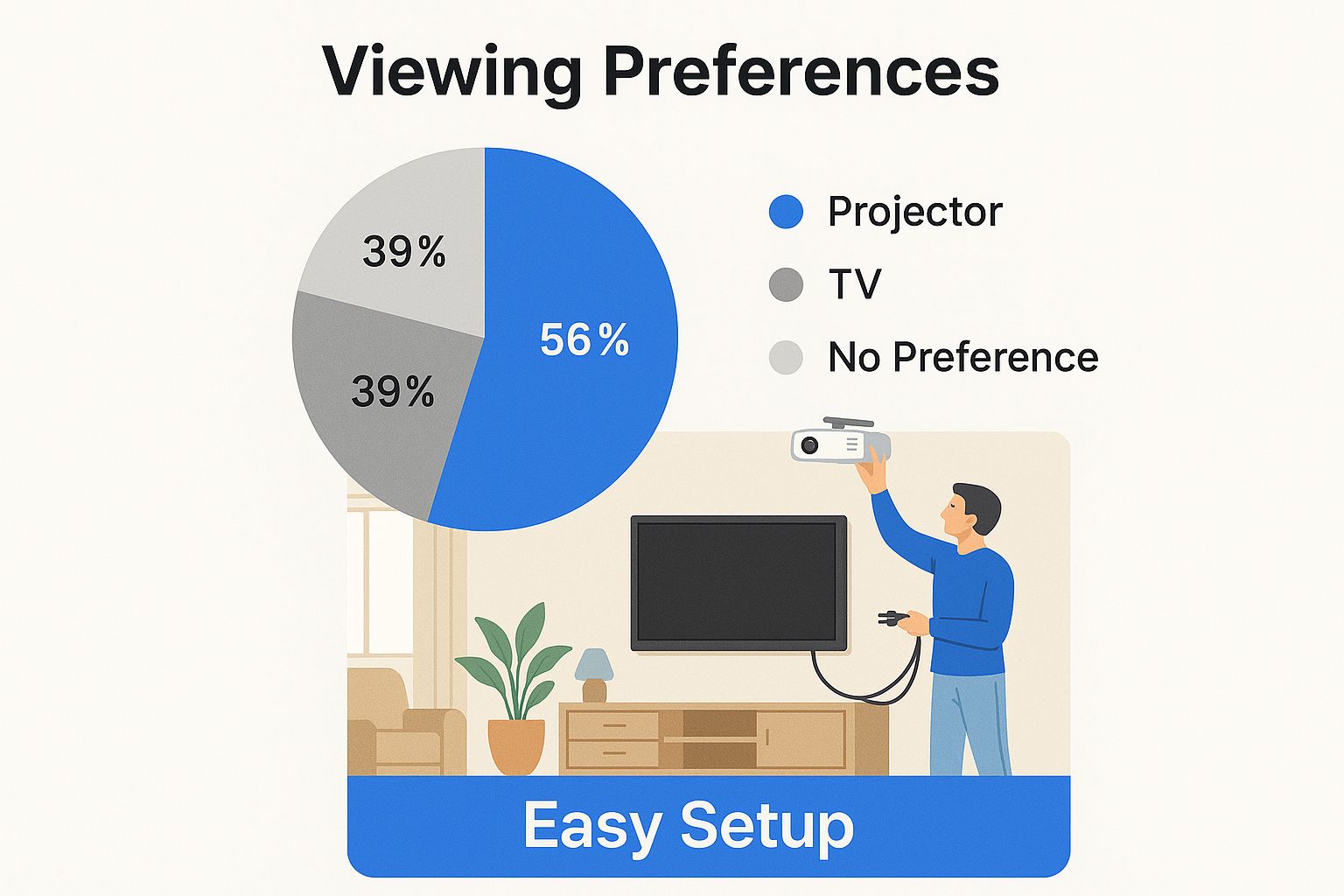
While a TV needs a direct wall mount, a projector setup requires careful positioning and cable routing, reinforcing the need to budget for the entire system, not just the box.
To give you a clearer idea, here’s how the costs might break down at different budget levels.
Total Cost of Ownership Projector vs TV at Different Tiers
| Component | Entry Level TV Setup (75″) | Entry Level Projector Setup (100″) | High End TV Setup (85″) | High End Projector Setup (120″) |
|---|---|---|---|---|
| Display | $1,200 (75″ 4K TV) | $800 (1080p Projector) | $3,000 (85″ OLED TV) | $3,500 (4K Laser Projector) |
| Screen | N/A | $200 (100″ Matte Screen) | N/A | $1,500 (120″ ALR Screen) |
| Mount | $100 (Wall Mount) | $75 (Ceiling Mount) | $150 (Full Motion Mount) | $100 (Ceiling Mount) |
| Sound System | $300 (Soundbar) | $300 (Soundbar) | $1,500 (AVR + Speakers) | $1,500 (AVR + Speakers) |
| Installation | $200 (Pro Install) | $350 (Pro Install) | $300 (Pro Install) | $500 (Pro Install) |
| Total Est. Cost | $1,800 | $1,725 | $4,950 | $7,100 |
As you can see, the initial costs can be surprisingly competitive at the entry level. However, the real financial story changes as your ambitions for screen size grow.
The Cost Per Inch Advantage
This is where projectors really start to shine. While a TV has a lower barrier to entry for smaller screens, the price explodes once you go past the 85-inch mark. A premium 98-inch TV can easily demand $8,000 or more. That’s a hefty price for a big screen.
In contrast, a projector’s cost-per-inch drops dramatically as the screen gets bigger. A fantastic $3,000 4K projector can effortlessly produce a stunning 120-inch image, a size that would be financially out of reach for most people with a TV.
For anyone who wants a screen larger than 85 inches, a projector system almost always offers better financial value. The upfront complexity is easily balanced by the massive savings per inch for a truly immersive, cinematic scale.
Long Term Ownership and Maintenance
The financial comparison doesn’t stop once everything is installed. You also have to think about long term costs like energy use and maintenance. Modern TVs, especially OLED models, are incredibly energy efficient.
Projectors, particularly older lamp models, use more power, and their bulbs need replacing every 3,000-5,000 hours. A replacement bulb can cost anywhere from $150 to $400. However, the game has changed with newer laser projectors. Their light sources can last 20,000 hours or more, which rivals the lifespan of a TV and practically eliminates that long term maintenance cost, making them a much more comparable investment over time.
Navigating Installation and Room Requirements
When you’re deciding between a projector and a TV, you’re not just choosing a screen; you’re making a fundamental decision about how you want the technology to exist in your room. This is where the two options really diverge. One is basically plug-and-play, while the other demands a more thoughtful approach to your space.
A big screen TV is pretty straightforward. You either set it on a stand or mount it to the wall. Sure, wrestling an 85-inch screen onto a wall mount isn’t a one man job, but the process itself is predictable. The real downside is its constant presence as a massive black rectangle that commands the room’s attention, even when it’s off.
A projector, on the other hand, can be incredibly discreet. When you’re done watching, the screen can retract completely out of sight, leaving your wall looking like, well, a wall. For living rooms where a large TV would feel like an eyesore, this disappearing act is a major advantage.
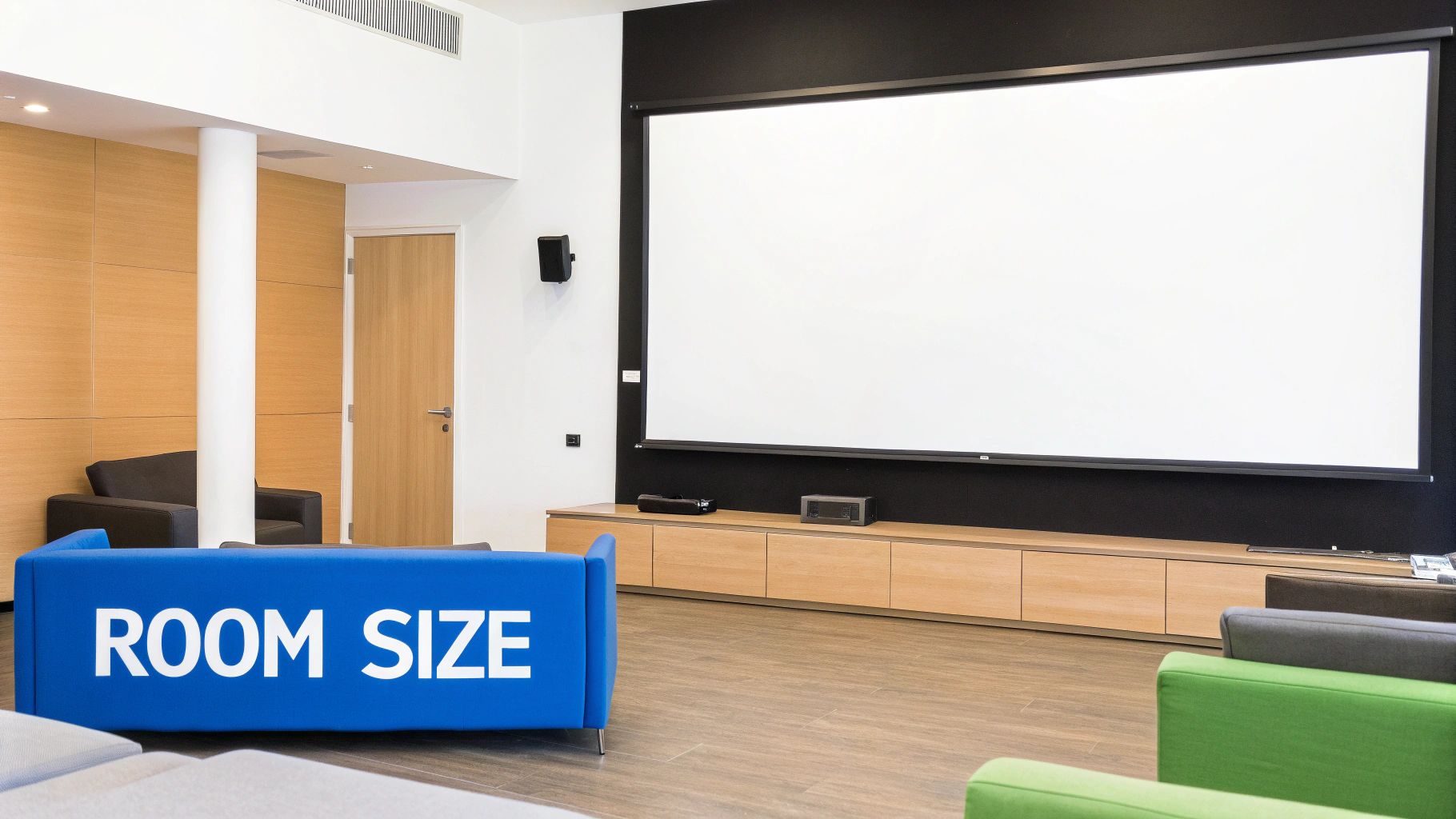
The Projector Installation Puzzle
Getting a projector set up is a whole different ballgame. It’s a project that requires real planning. You can’t just stick it anywhere. The projector’s location is dictated by a critical calculation known as throw distance, the exact distance it needs from the screen to project an image of a specific size.
This is step one, and you have to get it right. Every projector has a “throw ratio,” something like 1.5:1. This means that for every 1.5 feet of distance from the screen, the image gets 1 foot wider. So, for a 120-inch (10-foot wide) screen, that projector must be placed exactly 15 feet away. If you misjudge this, your image will either spill over the edges of your screen or be too small to fill it.
This single calculation determines where your projector can be mounted. A ceiling mount is the go to solution for a clean setup, but it comes with its own set of hurdles:
- Wiring: You have to figure out how to run power and an HDMI cable from your receiver or media player up to the ceiling mount without it looking like a mess.
- Alignment: Getting a perfectly square, sharp image isn’t automatic. It requires meticulous adjustments to the projector’s position, angle, and lens focus.
- Structural Support: You can’t just screw a mount into drywall. It has to be anchored securely into a ceiling joist to handle the projector’s weight safely.
The sheer complexity of a projector installation, from nailing the throw distance to hiding wires in the ceiling, is a huge part of the projector vs. TV debate. While it’s a possible DIY job for the handy, many people find the benefits of professional home theater installation are worth the investment just to get the perfect alignment and clean look without the headache.
The Critical Role of Light Control
Beyond the physical setup, the most important factor for a projector is light. A projector creates an image by throwing light onto a screen, which means any other light in the room is its natural enemy. This ambient light from windows, lamps, or even light bleeding in from another room competes directly with the projector, washing out the colors and making the picture look weak and faded.
For a TV, a bright room is a minor inconvenience. Its screen is a powerful light source that can easily overpower daylight. But for a projector, controlling ambient light is an absolutely non negotiable if you want a decent picture.
This is exactly why dedicated home theaters often have dark, matte paint and no windows. If you’re setting up in a regular living room, you’ll need practical solutions like blackout curtains or shades. Even a small amount of uncontrolled light can completely undermine the cinematic experience you paid for. While Ambient Light Rejecting (ALR) screens can help, they aren’t a magic fix and work best when you’re also managing the light in the room. In the end, how dark you can make your room is a major deciding factor.
Finding the Right Fit for Your Viewing Style
Technical specs and price tags are a huge part of the equation, but they don’t tell the whole story. The real secret to making the right choice between a projector and a TV is figuring out how it will fit into your actual life. The best screen is the one that matches your daily habits.
To help you sort it out, we’ve broken it down into a few common viewing styles. Find the one that sounds the most like you, and the right choice should become pretty clear.
The Dedicated Cinema Enthusiast
You live for movie nights. Your entire goal is to bring that commercial cinema magic home, complete with a screen so big it completely fills your vision. You have a room you can dedicate, a basement, a spare bedroom, or a media room where you can kill the lights and get close to total darkness.
For you, there’s really only one choice: a projector is the only answer. No TV on the market, not even a 98-inch model, can touch the pure scale and immersive feel of a 120-inch or larger projected image. It stops feeling like you’re watching a screen and starts feeling like you’re in the movie.
Your top priority is cinematic authenticity. You’re more than willing to control the room’s lighting for the perfect picture because, to you, a movie is an event, not just something to have on in the background.
The Daytime Sports Fan
Your living room is the center of the action. It’s bright, it’s busy, and it’s where everyone gathers for everything from the big game on a sunny afternoon to casual weeknight shows. You need a display that can punch through all that ambient light and still look vibrant without making everyone sit in the dark.
In this scenario, a large TV is the undisputed champion. Modern QLED and Mini-LED TVs are engineered for these exact conditions. Their powerful brightness levels make colors explode off the screen, even in a room filled with daylight. For a mixed use space where you can’t always control the lighting, their versatility is unbeatable.
The Competitive Gamer
Every single millisecond counts. Your world revolves around performance metrics like input lag (the tiny delay between a button press and the on screen action) and refresh rate. A massive, immersive screen is appealing, but you can’t afford to sacrifice even a hint of responsiveness.
This one is a close call, but for most competitive players, a high end gaming TV is the safer bet. Top tier TVs come equipped with dedicated game modes that can drop input lag below 15ms and support refresh rates of 120Hz or even 144Hz. The result is incredibly smooth, responsive gameplay. While some specialized gaming projectors are getting better, premium TVs still consistently deliver the lowest latency.
The Urban Apartment Dweller
You’re craving that epic screen experience, but you’re working with limited square footage. A massive, permanently mounted TV would completely overwhelm your living space, and a traditional projector that needs to be 10 feet from the wall just isn’t happening. You need a large screen scale without the large screen footprint.
This is where the ultra short throw (UST) projector is a game changer. A UST projector sits just inches from your wall but can throw up a stunning 100-inch image. It gives you that jaw dropping cinematic size, but the whole setup practically vanishes when you turn it off. It’s the perfect blend of scale and saving space for a modern living design.
If you’re looking for more ways to make a big impact in a smaller space, our guide on how to turn any room into a home theater has some great ideas.
Where Are Screens Headed Next?
The choice between a projector and a TV is getting tougher, primarily due to the rapid evolution of both technologies. If you want to make a wise, future proof investment for your home theater, you need to understand where things are going. The old debate was simple: size versus brightness. Now, it’s a much more interesting race where each side is working hard to fix its historic weaknesses.
Projectors are all about closing the convenience gap, making them a practical option for more than just a dedicated movie room. On the other side of the ring, TVs are in an all out war for the brightest, most perfect picture imaginable, pushing the limits of what you can see in a sunlit living room.
The Projector’s Comeback Story
The home theater projector market is definitely having a moment, thanks to some clever innovations that finally address those old pain points. The global market was valued at USD 5.2 billion in 2023 and is on track to nearly double to USD 10.1 billion by 2033. That kind of growth shows a real hunger for massive, cinema style experiences at home. You can dig into the numbers yourself with this full market analysis on DataHorizzonResearch.com.
Two huge developments are driving this surge:
- Goodbye, Bulbs. Hello, Lasers: The biggest leap forward is the move away from old school lamps to laser and LED light sources. These solid state engines mean you can forget about expensive bulb replacements. They offer lifespans of 20,000 hours or more, which is right on par with a typical TV. Just like that, a major maintenance headache is gone.
- The Rise of the UST: Ultra Short Throw (UST) projectors have been a game changer, bringing huge screens into smaller homes and apartments. They sit just inches from the wall, so you don’t need to worry about ceiling mounts or complicated distance math. It’s a simple “place and play” setup that directly competes with the ease of a TV.
The trend for projectors is crystal clear: they are becoming brighter, longer lasting, and way easier to install. The endgame is to give you that jawdropping cinematic scale without the old school compromises on maintenance and setup headaches.
The TV Technology Arms Race
While projectors are chasing convenience, TV manufacturers are locked in a relentless pursuit of visual perfection. The competition is incredibly fierce, with different technologies now specializing in different areas, giving you more tailored options than ever. This constant battle for the best picture quality ensures the TV will remain a powerhouse in the home entertainment world.
The main front in this war is the fight to master brightness and contrast in any room, regardless of the amount of light pouring in. This focus makes modern TVs an incredibly strong choice for mixed use living spaces where you can’t always draw the blinds.
Here are the key players shaping the future of your TV screen:
- OLED Gets Even Better: OLED has long been the king of perfect black levels and infinite contrast. The next evolution is all about pushing peak brightness for more impactful HDR and improving longevity to further minimize any risk of burn in.
- Mini LED and QLED Take Over: For bright room viewing, Mini LED and QLED TVs are leading the pack. By cramming thousands of tiny LEDs behind the panel, they can hit insane brightness levels and achieve incredibly precise local dimming. The result is a stunning contrast that gets closer and closer to what OLED can do, but without giving up any brightness.
At the end of the day, the projector vs. TV decision is only going to get more interesting. Projectors are rapidly catching up on the practicality front, while TVs are conquering daytime viewing. This is great news for all of us. No matter which you choose, you’re investing in technology that’s only getting better, making amazing visual experiences more accessible than ever before.
Answering Your Top Projector vs TV Questions
Once you’ve weighed the pros and cons, a few practical questions usually pop up before making that final projector vs TV home theater decision. Getting these answers right is the key to choosing a setup you’ll love for years.
Can a Projector Really Replace My Everyday TV?
This is a big one. Can a projector handle your daily channel surfing and news updates? While modern projectors are more capable than ever, they really shine during intentional viewing sessions, think movie nights, big games, or immersive gaming.
The reality is that you need to dim the lights, and there’s a slight startup time. This makes them a bit clunky for flipping on the morning news while making coffee.
For daily news, casual shows, and background entertainment in a bright room, a TV remains the more convenient and practical choice. A projector excels as a dedicated event screen, not an all day display.
Light Source Longevity and Replacement Costs
The lifespan of a projector’s bulb used to be a major drawback. Traditional lamp based models needed a bulb replacement every 3,000 to 5,000 hours. With new bulbs running between $150 and $400, this created a recurring cost that TVs just don’t have.
But the industry has moved on. Newer laser and LED projectors have completely changed the game. Their light sources are rated for 20,000 hours or more. To put that in perspective, that’s enough for a two hour movie every single day for over 27 years. This essentially eliminates replacement costs, putting them on equal footing with TVs for long term value.
Can a Projector Look as Bright as a TV?
In a perfectly dark room, a great projector delivers a breathtakingly vibrant image. But in a head-to-head brightness battle with daylight streaming in, a TV will win every time. TVs generate their own light, allowing them to punch through ambient light with ease.
A projector’s brightness is measured in lumens, and its image is always fighting the light in the room. While it can’t match a TV’s raw power, you can give it a serious fighting chance by pairing it with a specialized Ambient Light Rejecting (ALR) screen. These screens are engineered to reflect the projector’s light straight back to you while absorbing light coming from other angles.
This combo, a high lumen projector and an ALR screen, creates a surprisingly crisp and watchable picture, even with some lights on. Although it won’t be as dazzling as a top tier QLED in direct sun, it makes a projector a much more flexible option for living rooms than it was in the past.
At TV Mounting Houston, we know the perfect setup is more than just the screen. Whether you land on a massive TV or a sophisticated projector system, our experts guarantee a flawless, professional installation. Get your free quote today and let us build the home theater you’ve always wanted.


