
Find Your Optimal TV Viewing Height
That little ache in your neck after a movie marathon? That’s not just a sign of a good binge-watch; it’s your body telling you the TV is mounted at the wrong height. The sweet spot for optimal TV viewing height is with the center of the screen at, or just a hair above, your eye level when you’re seated. Nailing this one detail is the difference between a decent setup and a truly incredible home theater experience.
Why Your TV Height Matters More Than You Think
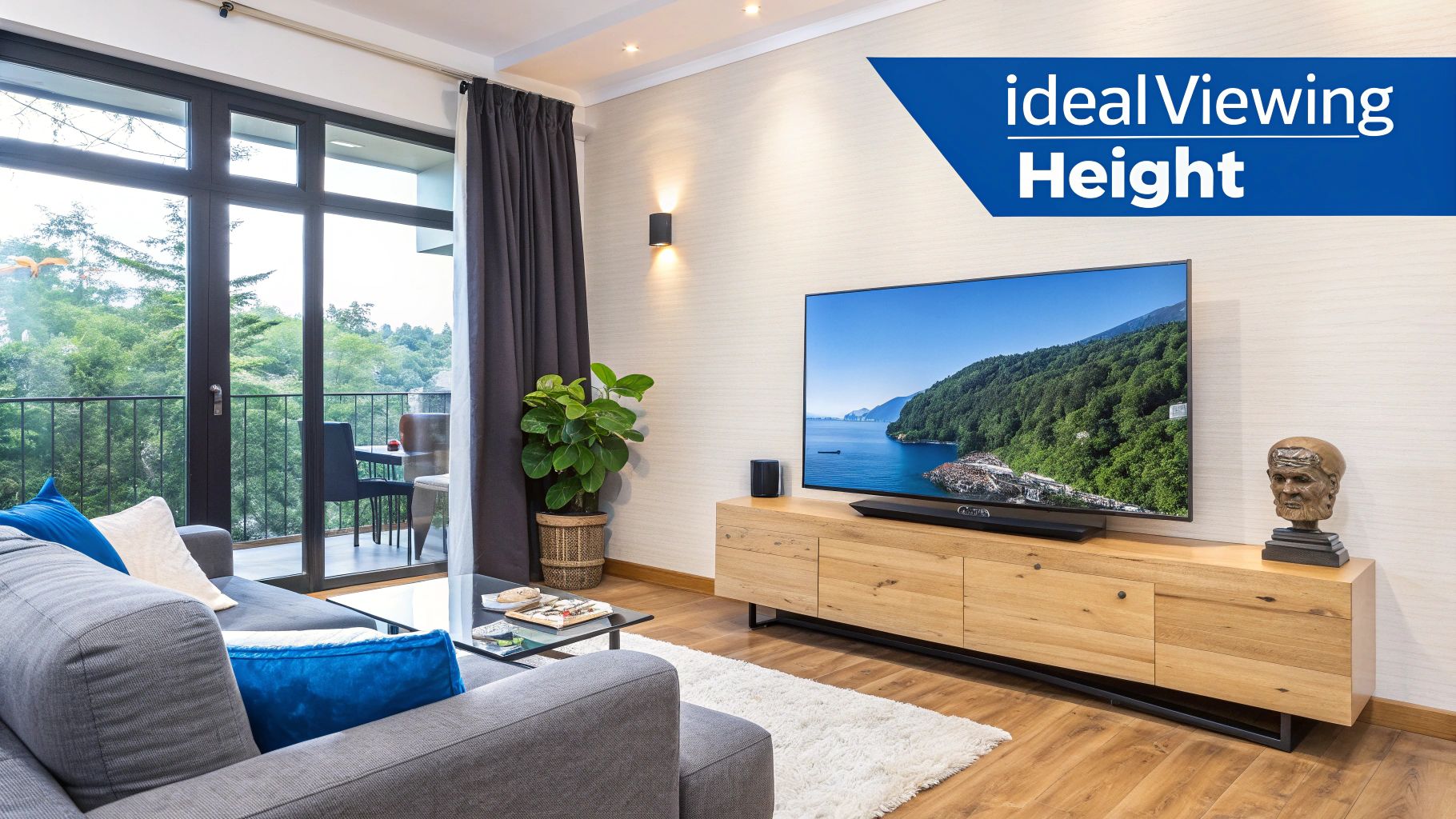
Figuring out where to put your TV is about so much more than just aesthetics. It’s an ergonomic decision that has a real, physical impact on your comfort and how much you enjoy your downtime. A badly positioned screen forces you into awkward postures that can lead to more than just a passing cramp.
Mounting a TV too high is probably the most common mistake we see, especially over fireplaces. It forces you to crane your neck backward, putting a constant strain on the muscles in your neck and shoulders. On the flip side, a TV that’s too low will have you slouching forward, which can lead to its own set of back and posture problems over time.
The Impact on Viewing Quality
Beyond the physical strain, getting the height wrong actually makes the picture worse. Modern TVs, particularly OLED and many LCD models, are designed with an optimal viewing angle. If you’re watching from too far above or below the screen, you’ll notice shifts in color accuracy, contrast, and brightness. The picture you see simply isn’t what the director intended.
This problem becomes really obvious during dark, moody scenes where crucial details can get completely washed out if your line of sight isn’t right. It also makes glare and reflections from lights and windows a much bigger issue, further tanking the picture quality.
“The goal is a natural viewing experience where your eyes rest near the center of the screen without strain. This simple adjustment reduces eye fatigue and neck pain, allowing for far greater immersion in whatever you’re watching.”
More Than Just a Screen
At the end of the day, optimizing your TV height is about getting the most out of your investment. You picked out that specific television for its incredible picture quality, but improper placement can cancel out all those benefits. By taking a few moments to get the height right, you ensure every movie night or gaming session is as comfortable and visually stunning as it was meant to be. It’s what separates a setup that just looks good from one that actually feels right.
The Core Formula for Perfect TV Placement
Forget about guesswork or pulling a random number out of the air. Figuring out the best height to mount your TV isn’t an art form—it’s a science, and there’s a straightforward formula that pros like us rely on every single day. The entire calculation starts with one critical measurement: your seated eye level.
This isn’t some generic average; it’s about your actual viewing posture. Grab a tape measure and have a friend help you out. Sit down on your couch or primary viewing chair just like you would for a movie night. Are you a sloucher? Do you sit perfectly upright? Have them measure from the floor right up to your eye level. That number is your starting point.
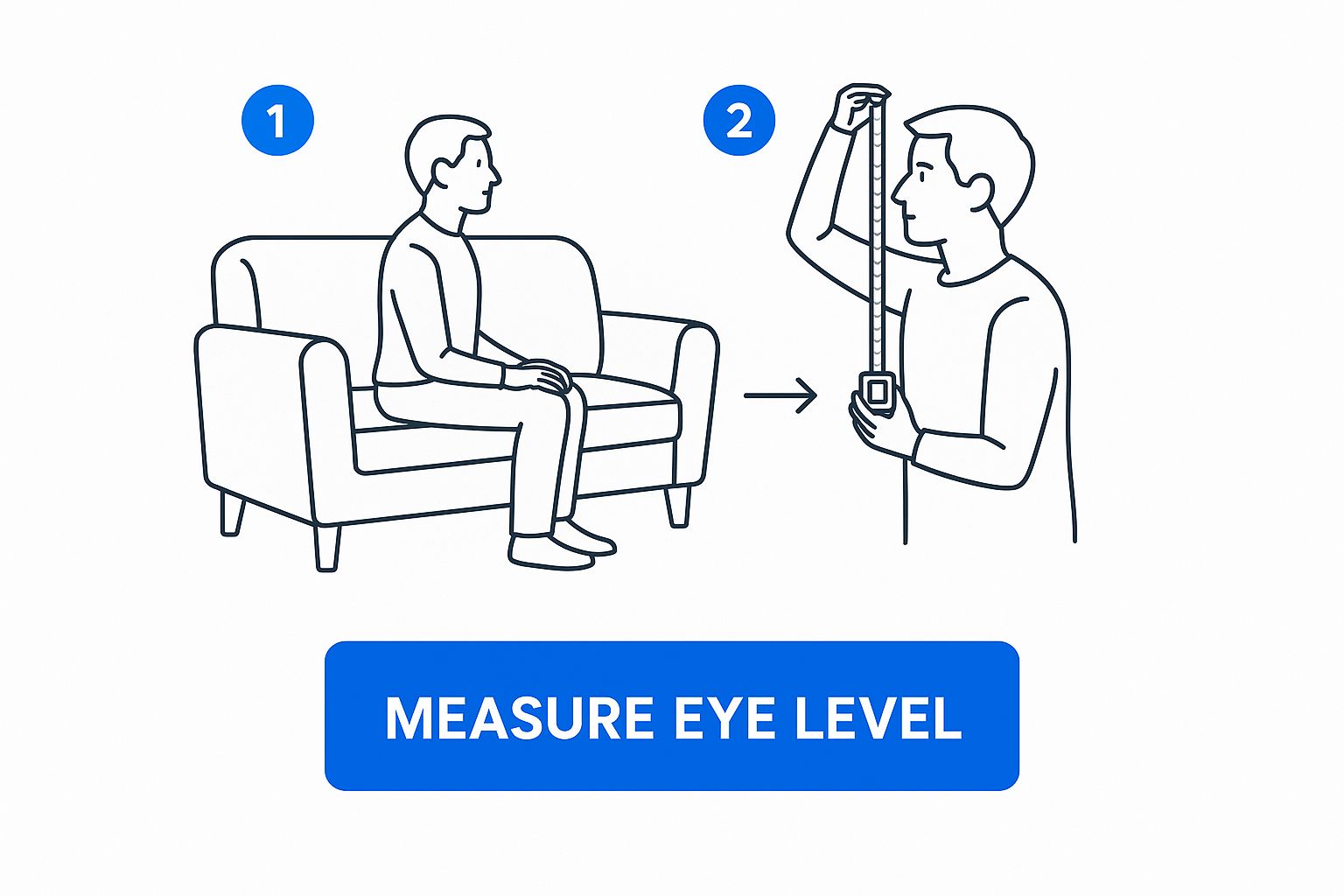
As you can see, getting an accurate measurement from your main seat is the absolute foundation for a comfortable, ergonomic setup.
Applying the 22% Guideline
Once you have your eye-level measurement, you’re ready for the next piece of the puzzle. There’s an industry-accepted guideline that strikes the perfect balance between comfortable ergonomics and an immersive viewing experience. The rule is that the vertical center of your TV screen should be about 22% of the viewing distance above your seated eye level.
This slight upward angle keeps your neck in a neutral, relaxed position while making the screen feel perfectly placed. It’s a subtle but crucial adjustment. For a deeper dive into how this works in different rooms, you can check out our complete guide on the ideal height to mount your TV.
This formula is the secret to marathon viewing sessions without the pain. It ensures your eyes naturally land on the center of the screen with just a slight upward tilt, completely avoiding the neck strain that comes from looking too far up or down.
To make things even easier, here’s a quick reference table. Just find your viewing distance to see the recommended height for the center of your TV.
Quick TV Center Height Calculation
This table helps you quickly calculate the recommended center mounting height for your TV, based on a standard 40-inch seated eye level and your viewing distance.
| Viewing Distance (Feet) | Calculation (Inches) | Recommended TV Center Height from Floor (Inches) |
|---|---|---|
| 8 Feet | (96 inches x 0.22) + 40 inches | 61.12 inches |
| 9 Feet | (108 inches x 0.22) + 40 inches | 63.76 inches |
| 10 Feet | (120 inches x 0.22) + 40 inches | 66.40 inches |
| 11 Feet | (132 inches x 0.22) + 40 inches | 69.04 inches |
| 12 Feet | (144 inches x 0.22) + 40 inches | 71.68 inches |
Remember, this is a starting point using a 40-inch eye level. For the most accurate results, use your personal eye-level measurement in the calculation.
Putting It All Together: A Real-World Example
Let’s walk through how this works in a typical living room.
Imagine you just bought a new 65-inch TV. Your sofa is nine feet (108 inches) from the wall where the TV will go. After measuring, you find your seated eye level is 36 inches from the floor. Now, we just plug those numbers into the formula.
- First, find the upward adjustment: Multiply your viewing distance by 22%.
- 108 inches x 0.22 = 23.76 inches
- Next, add that to your eye level: This gives you the final height for the center of the screen.
- 36 inches + 23.76 inches = 59.76 inches
So, for this setup, the center of your 65-inch TV should be mounted about 60 inches off the floor. This method creates a precise, customized target for your TV mount that’s perfectly tailored to your room and how you actually watch TV.
How Screen Size and Distance Change Everything
When you’re figuring out the perfect TV height, screen size and viewing distance are the two biggest players in the game. It’s a balancing act. A huge 75-inch screen in a massive living room needs a totally different approach than a 55-inch TV in a cozy den. Nailing this relationship is what separates a decent setup from one that feels truly cinematic.
A common mistake is thinking “eye-level” is a fixed measurement. In reality, it’s all relative to the scale of your screen. Think about a movie theater—the screen is gigantic, and your seat is placed at a specific distance so you can take it all in without getting a headache. This is all about achieving the right field of view.
Decoding the Field of View
So, what does that mean for your living room? We can lean on the experts for some solid guidelines. The Society of Motion Picture and Television Engineers (SMPTE) suggests that for a comfortable and engaging experience, your screen should fill about 30 degrees of your vision. If you’re a movie buff who wants that intense, immersive feel, you’ll want to aim for 40 degrees.
This professional standard has a direct impact on how high you should mount your TV. For a more detailed breakdown of how this works with different screen sizes, our TV size and viewing distance guide has you covered.
For example, to get that 30-degree field of view with a 65-inch TV, you should be sitting about nine feet away. This distance works hand-in-hand with the height calculations to create a setup that’s both comfortable and visually stunning. You can find more professional insights on how these calculations come together over on kef.com.
The whole point is to avoid the “tennis match effect.” You don’t want your head constantly swiveling back and forth to follow the action on a screen that’s too big for your seating distance. A well-balanced setup lets your eyes relax and just absorb the picture.
Practical Distance Guidelines
Don’t worry, you don’t need to break out a protractor to figure this out. We can translate those viewing angles into simple, real-world distances based on the most common TV sizes.
This table gives you a great starting point for finding your ideal viewing distance based on THX and SMPTE recommendations for an immersive experience.
| Recommended Viewing Distance by TV Screen Size | ||
|---|---|---|
| Screen Size (Diagonal) | Recommended SMPTE Distance (Approx.) | Recommended THX Distance (Approx.) |
| 55-inch | 7.6 feet | 5.5 feet |
| 65-inch | 9.0 feet | 6.5 feet |
| 75-inch | 10.4 feet | 7.5 feet |
| 85-inch | 11.8 feet | 8.5 feet |
You’ll notice that the THX recommendation, which is geared for a more cinematic feel, has you sitting quite a bit closer. This really comes down to personal taste.
If you love being completely pulled into your movies, aim for that closer THX distance. If you’d rather have a more traditional and relaxed viewing experience, the SMPTE guideline is a fantastic and comfortable standard. Once you’ve figured out your ideal spot, you can use that information to lock in the perfect vertical height for your TV mount.
Going Beyond the Math to Find Your Perfect Height
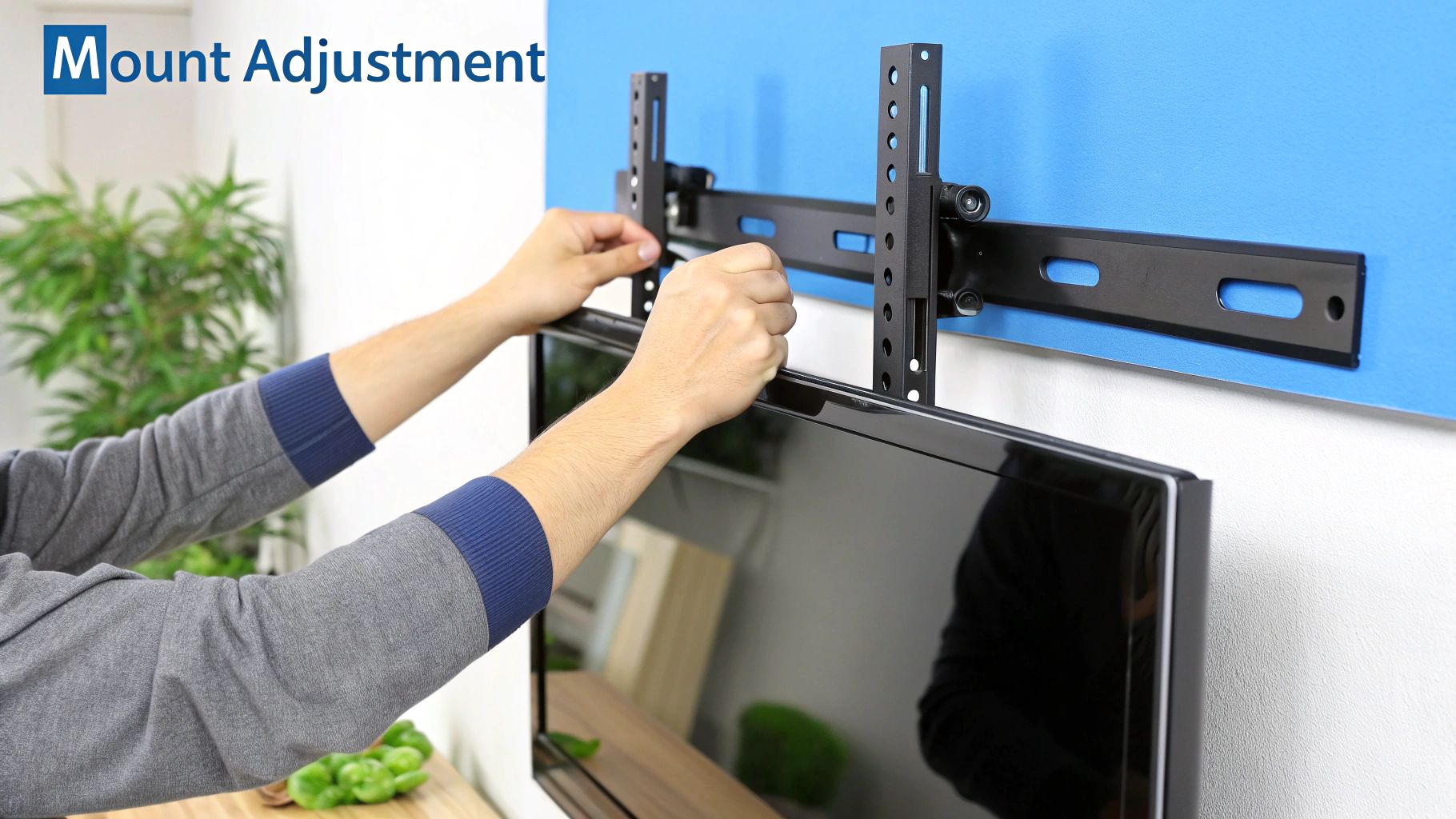
While the formulas we’ve covered give you a fantastic, science-backed starting point, they don’t account for the final, most important variable: you. Finding the truly optimal TV viewing height is really a blend of precise calculation and personal intuition. The numbers get you in the ballpark, but the final few inches often come down to what just feels right in your unique space.
This feeling isn’t random guesswork, either. There’s a real psychological component to how we see screens in our environment. A TV mounted at a mathematically perfect eye-level can sometimes feel underwhelming or even too low, especially in a large, open-concept room with high ceilings.
The Psychology of Perception
Believe it or not, our brains are constantly adjusting our perception of size based on distance. A fascinating study on viewers watching an 8K TV found that when the viewing distance was doubled, their preferred on-screen image size only needed to increase by about 10% to feel just as immersive.
What does that tell us? It suggests our minds are working behind the scenes to maintain a consistent experience, something a simple tape measure can’t possibly predict. You can dive into the fascinating details in this study on viewer perception and screen size. This cognitive element is exactly why personal preference has to play a role. The calculated height is your baseline, not the final word.
Your TV doesn’t exist in a vacuum. It’s part of your home’s ecosystem. The final placement should feel balanced and intentional, complementing the furniture, wall space, and overall flow of the room.
Trusting Your Aesthetic Instincts
Aesthetics are just as important as ergonomics. I’ve seen perfectly calculated setups that just looked wrong because they didn’t account for the room itself. The visual harmony between your screen and its surroundings can make or break the final result.
Before you drill any holes, ask yourself a few key questions:
- Wall Proportions: Does the screen feel centered and balanced on this particular wall, or does it look awkwardly high or low?
- Furniture Harmony: How does the TV line up with other elements like a media console, speakers, or nearby artwork? A screen that aligns cleanly with the top of a console often creates a much more cohesive, professional look.
- The Vibe: Are you aiming for a cozy, intimate feel or a grand, cinematic one? Mounting the TV just a touch higher can contribute to a more dramatic, theater-like atmosphere, even if it breaks the strict eye-level rule.
Ultimately, the best approach is to use the formula as your guide, not your gospel. Grab a big piece of cardboard cut to your TV’s size or just use painter’s tape to mark the outline on the wall. Live with it for a day or two. Don’t be afraid to nudge it up or down by a few inches until it feels absolutely perfect to you.
Practical Adjustments For Real-World Living Rooms
The formulas give you a fantastic baseline, but let’s be honest—most living rooms aren’t perfect home theater labs. Real life means dealing with architectural quirks, mismatched furniture, and windows that seem to catch the sun at the worst possible times. This is where you move from theory to practice, adapting the rules to make sure the optimal TV viewing height works for your actual home, not just on paper.
One of the most common challenges we see is the dreaded fireplace mount. While it’s a popular look, placing a TV above a mantle almost always positions it way too high for comfortable viewing. This forces a constant upward gaze that can lead directly to neck strain.
If mounting over a fireplace is your only option, a tilting wall mount becomes non-negotiable. It lets you angle the screen downward, aiming the picture right at your seating area. This simple adjustment makes a world of difference for comfort and cuts down on the picture distortion that comes from viewing at an extreme vertical angle.
For a complete walkthrough of the entire installation process, our guide on how to mount a TV on a wall breaks down every step in detail.
Handling Different Seating and Viewers
So, what happens when your living room has a low-slung sofa and a high-backed armchair? Whose eye level gets priority? In situations like this, compromise is everything. You can’t make it perfect for everyone, but you can definitely find a happy medium.
A good strategy is to prioritize the seating that gets the most use. If the family spends 90% of its time on the sofa, use that as your primary measurement. Another great approach is to just split the difference—calculate the ideal height for both the sofa and the armchair, then mount the TV at a point halfway between them.
This way, no single viewer has a terrible experience, even if no one has the absolutely perfect one.
The best solution is often a compromise that serves the room’s main purpose. It’s better to have a setup that is ‘very good’ for everyone than one that is ‘perfect’ for one person and ‘uncomfortable’ for everyone else.
Adapting to Recliners and Bedrooms
Reclining seats throw another variable into the mix. As soon as you lean back, your eye level drops and your viewing angle changes completely. If you’re a dedicated recliner user, your best bet is to measure your eye level from your fully reclined position. This will almost always result in a slightly higher mounting point than you’d use for a standard sofa.
Bedrooms present their own unique challenge. You’re typically lying down or propped up against pillows, which means your natural line of sight is much higher up the wall.
- Measure while reclined: Get into your usual TV-watching position in bed and measure your eye level from there.
- Mount higher: The center of the TV will almost always be mounted higher in a bedroom than in a living room—and that’s okay.
- Use a tilt mount: Angling the screen down is absolutely essential to get a direct, clear picture without having to crane your neck.
Finally, never forget about window glare. Before you even think about drilling, check the proposed TV spot at different times of the day. If you notice significant reflections from a nearby window, you might need to shift the TV’s position or invest in some better curtains. Making these practical adjustments is the final, crucial step in achieving a truly comfortable and enjoyable viewing setup.
A Few Final Questions Before You Drill
Even with all the right formulas and careful measurements, a few questions always seem to pop up right before the drill comes out. Getting these last-minute details right is what turns a good setup into a great one, making sure your perfect TV height works in the real world, not just on paper. Let’s walk through some of the most common dilemmas we run into.
How Can I Be 100% Sure About the Height Before Making Holes?
This is easily the most frequent question we get, and the answer is surprisingly simple: use painter’s tape. Before you even think about drilling, grab a tape measure and mark out your TV’s exact dimensions on the wall.
Live with that blue rectangle for a day or two. See how it looks from your favorite spot on the couch, from the kitchen, or wherever you’ll be watching. This is the single best way to gut-check your calculations and confirm the height feels right in your space before you commit.
What About My Soundbar? Where Does It Go?
Another classic point of confusion. The rule here is simple: always prioritize the screen. Figure out the ideal viewing height for your TV first, and then work the soundbar in around it.
Most setups look best with the soundbar mounted directly below the TV. Just make sure you leave a bit of breathing room—usually 2 to 4 inches is perfect. This gap ensures the soundbar doesn’t block the TV’s remote sensor and gives the whole setup a clean, intentional look.
Your viewing experience is tied directly to the center of that screen. Get the TV mounted for perfect ergonomics first, then find a home for your audio. A great picture is always more important than a perfectly centered soundbar.
Is It Really Worth Hiring a Pro to Do This?
This is the big one. Can you mount a TV yourself? Of course. But is paying a professional installer worth it? For a lot of people, the answer is an absolute yes.
Think about these things before you decide to DIY it:
- What’s Your Wall Made Of? Brick, concrete, and old plaster walls can be incredibly tricky. A pro has the right tools and experience to anchor a mount safely into these surfaces without causing damage.
- How Big Is Your TV? Hanging an 85-inch TV isn’t just a two-person job; it’s a high-stakes one. If it’s not secured perfectly, it’s a huge risk.
- Do You Hate Wires? If you want that clean, floating TV look with no visible cables, an installer can professionally run everything behind the drywall. That’s a complex task that can go wrong quickly for the average homeowner.
Hiring a professional buys you peace of mind. It’s a guarantee that your TV will be level, securely fastened to studs, and positioned at the exact height you spent all this time calculating. More importantly, it eliminates the risk of a costly (or dangerous) mistake.
Ready to skip the guesswork and get it done right the first time? The experts at TV Mounting Houston offer same-day service to get your TV mounted perfectly, every time. Learn more about our professional TV mounting services.


